Kilimo Corps Institute · Professional Programme

Cohort I — August–September 2026

Professional Certificate in Hydroponic Farming & Enterprise Development

Kilimo Corps Institute’s practical professional programme for farmers, agripreneurs and agricultural practitioners seeking to establish productive and commercially viable hydroponic farming enterprises.

Grow more with less water, limited space and year-round production systems.

Applications are currently open
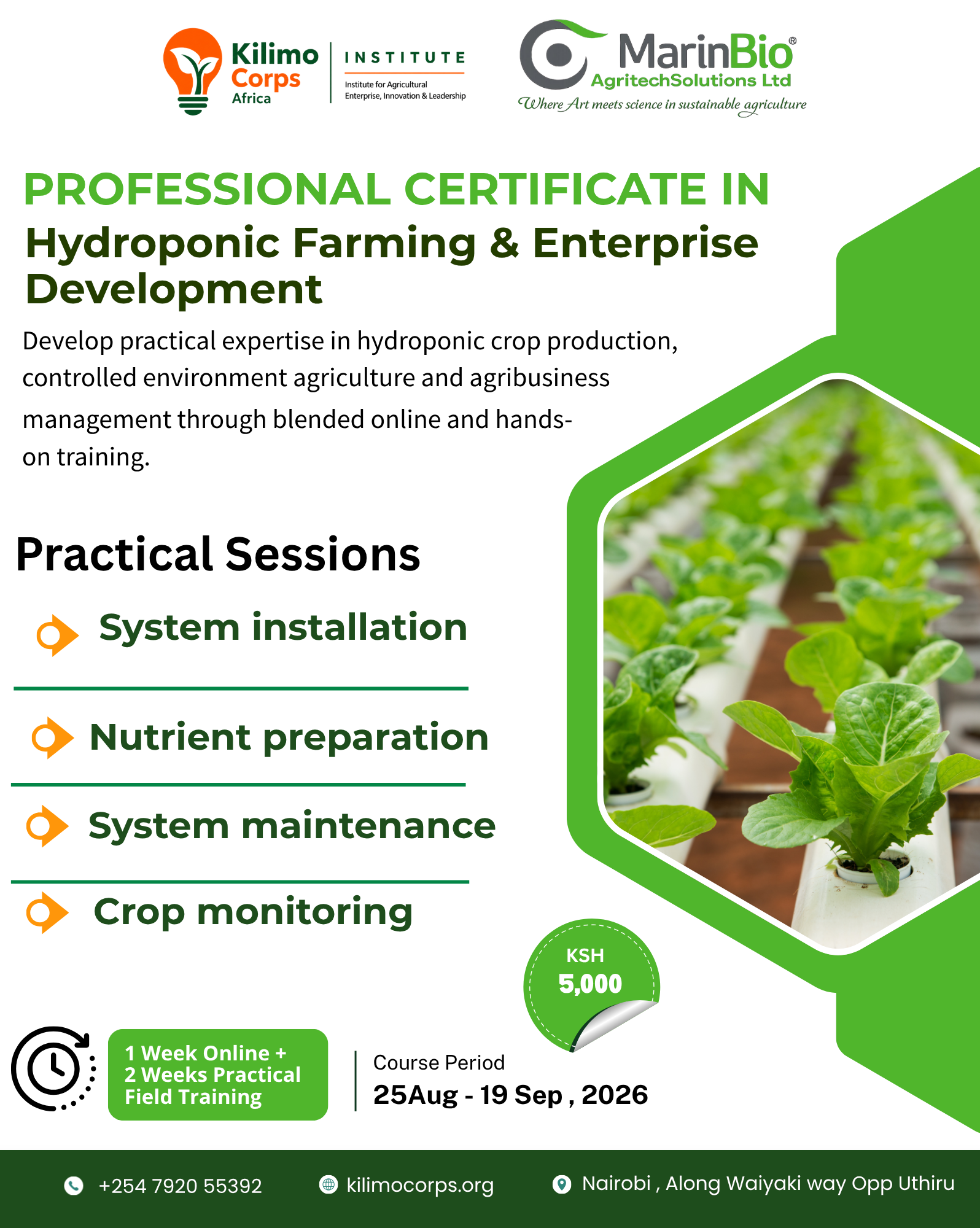
Official poster for the Professional Certificate in Hydroponic Farming and Enterprise Development, 25 August to 19 September 2026
Official Cohort I programme poster · Open full size
Dates25 August–19 September 2026
DurationThree weeks of instruction
StructureOne week online plus two weeks practical
ModeBlended learning
Practical locationNairobi
FeeKES 5,000
AwardProfessional Certificate of Completion
Experience requiredNone

Programme overview

From soilless-production principles to a viable hydroponic enterprise.

The Professional Certificate in Hydroponic Farming & Enterprise Development is a blended professional programme designed to equip participants with the technical knowledge, practical skills and enterprise competencies required to establish and manage commercially viable hydroponic farming systems.

Delivered by Kilimo Corps Institute in collaboration with MarinBio Agritech Solutions Ltd, the programme combines structured online learning with intensive practical field training. Participants explore the complete hydroponic production cycle—from system selection and installation to growing-media management, nutrient preparation, crop production, water-quality monitoring, pest management, harvesting and enterprise development.

The programme demonstrates how modern soilless farming technologies can improve water efficiency, support year-round production and create new agricultural enterprises in urban, peri-urban and rural environments.

Who should apply?

For people ready to build modern food-production capability.

  • Farmers
  • Agripreneurs and agribusiness owners
  • Young people interested in modern farming
  • Urban and peri-urban farmers
  • Agricultural and TVET students
  • Agricultural extension officers
  • Schools and training institutions
  • NGOs and community-based organizations
  • Investors exploring controlled-environment agriculture
  • People interested in water-efficient food production

Learning outcomes

What participants should be able to do.

  • Explain the principles of hydroponic and soilless farming
  • Compare common hydroponic production systems
  • Select an appropriate system for a crop, market and operating environment
  • Design and install a basic hydroponic production system
  • Select and manage suitable growing media
  • Prepare and manage nutrient solutions
  • Monitor pH, electrical conductivity and water quality
  • Establish healthy seedlings and transplant them correctly
  • Produce leafy vegetables and herbs using soilless systems
  • Prevent and manage common pests, diseases and production disorders
  • Harvest, handle, package and market hydroponic produce
  • Develop a practical and financially viable hydroponic enterprise plan

Programme modules

Ten connected modules across systems, crops and enterprise.

01

Introduction to Hydroponic Farming

Explore hydroponics as a controlled crop-production method, its operating principles and where it can create value in urban, peri-urban and rural settings.

02

Principles of Soilless Agriculture

Understand how plants receive water, oxygen and nutrients without field soil, and the management responsibilities this creates for growers.

03

Hydroponic Systems and Infrastructure

Compare common production systems and learn how site, crop, scale, utilities and maintenance needs shape an appropriate system choice.

04

Growing Media and Nutrient Solutions

Examine suitable growing media and develop safe routines for preparing, monitoring and adjusting crop nutrient solutions.

05

Crop Selection and Nursery Management

Select crops suited to the intended system and market, then establish strong seedlings for successful transplanting.

06

Crop Production and System Management

Build practical routines for irrigation, environmental observation, crop monitoring, sanitation, record keeping and routine system care.

07

Integrated Pest and Disease Management

Recognize common production risks and apply preventive, monitoring and response measures that protect crop health and product quality.

08

Harvesting and Post-Harvest Handling

Plan harvest timing and apply careful handling, packaging and storage practices suited to fresh hydroponic produce.

09

Enterprise Development and Marketing

Connect production decisions to customers, pricing, quality expectations, routes to market and a credible enterprise value proposition.

10

Business Planning and Investment Opportunities

Translate the technical system into an operating plan with realistic costs, revenue assumptions, risks, milestones and investment needs.

Practical field training · Nairobi

Weeks 2–3 turn online learning into supervised practice.

Final reporting instructions and the precise practical-training venue will be communicated to successfully registered and confirmed participants.

  • Hydroponic system installation
  • Nutrient-solution preparation
  • Growing-media preparation
  • Seedling establishment
  • Transplanting
  • pH and electrical-conductivity testing
  • Water-quality monitoring
  • Crop monitoring
  • Pest and disease identification
  • Harvesting and post-harvest handling
  • System cleaning and maintenance
  • Basic production planning and record keeping

Programme benefits

Support for applied learning.

  • Professional Certificate of Completion
  • Online learning resources
  • Practical field experience
  • Technical support
  • Industry mentorship
  • Enterprise-development guidance
  • Access to a community of hydroponic practitioners
  • Opportunities for future advanced training

Career and enterprise pathways

Where these capabilities can lead.

  • Hydroponic farm ownership
  • Urban and peri-urban farming enterprises
  • Protected-agriculture technician
  • Greenhouse or hydroponic systems manager
  • Hydroponic system installation and maintenance
  • Agricultural extension and consulting
  • Fresh-produce production and marketing
  • Controlled-environment agriculture
  • Agricultural training and demonstration services

Why choose this programme?

Professional learning grounded in production realities.

  • Industry-relevant curriculum
  • Blended and flexible learning
  • Intensive practical application
  • Experienced agricultural practitioners
  • Production and enterprise development
  • Water-efficient farming systems
  • Relevance to urban and climate-resilient agriculture
  • Affordable professional development

Official payment instructions

Pay securely through M-PESA Paybill

Business number
400200
Account number
1172301
Business name
Pith Kilimo Solutions
Amount
KES 5,000
Registration
Applications are currently open
  1. Open the M-PESA menu and select Lipa na M-PESA.
  2. Select Pay Bill and enter Business Number 400200.
  3. Enter Account Number 1172301.
  4. Enter KES 5,000.
  5. Confirm that the displayed business name is Pith Kilimo Solutions.
  6. Complete payment and retain the M-PESA confirmation message.

Before entering your M-PESA PIN, confirm that the business name displayed is Pith Kilimo Solutions. Your registration will only be confirmed after Kilimo Corps Institute verifies your payment. Keep your M-PESA confirmation message or receipt as proof of payment.

Entry requirements

No previous hydroponics experience is required.

  • Be at least 18 years old
  • Have an interest in agriculture, agribusiness or food production
  • Be available for the Nairobi practical sessions
  • Have access to a smartphone, tablet or computer for online learning
  • Be able to participate during the stated programme period

No previous experience in hydroponic farming is required.

Delivery partners

Kilimo Corps Institute

Kilimo Corps Institute is the education and professional-development arm of Kilimo Corps Africa. It delivers practical, industry-focused programmes that equip learners with the knowledge, skills and leadership required to build resilient agricultural enterprises and sustainable food systems across Africa.

MarinBio Agritech Solutions Ltd

MarinBio Agritech Solutions Ltd develops sustainable agricultural innovations that transform biological science into practical solutions for food production, environmental management and enterprise development. Through research, innovation and commercialization, the company advances technologies that improve agricultural productivity and sustainability.

Applications are now open for Cohort I.

Move from technical knowledge to practical production and enterprise development.

Whether you want to establish a hydroponic enterprise, improve an existing farming operation or gain practical expertise in controlled-environment agriculture, this programme will help you move from technical knowledge to practical production and enterprise development.Learn. Practice. Build. Lead.Apply for Cohort I